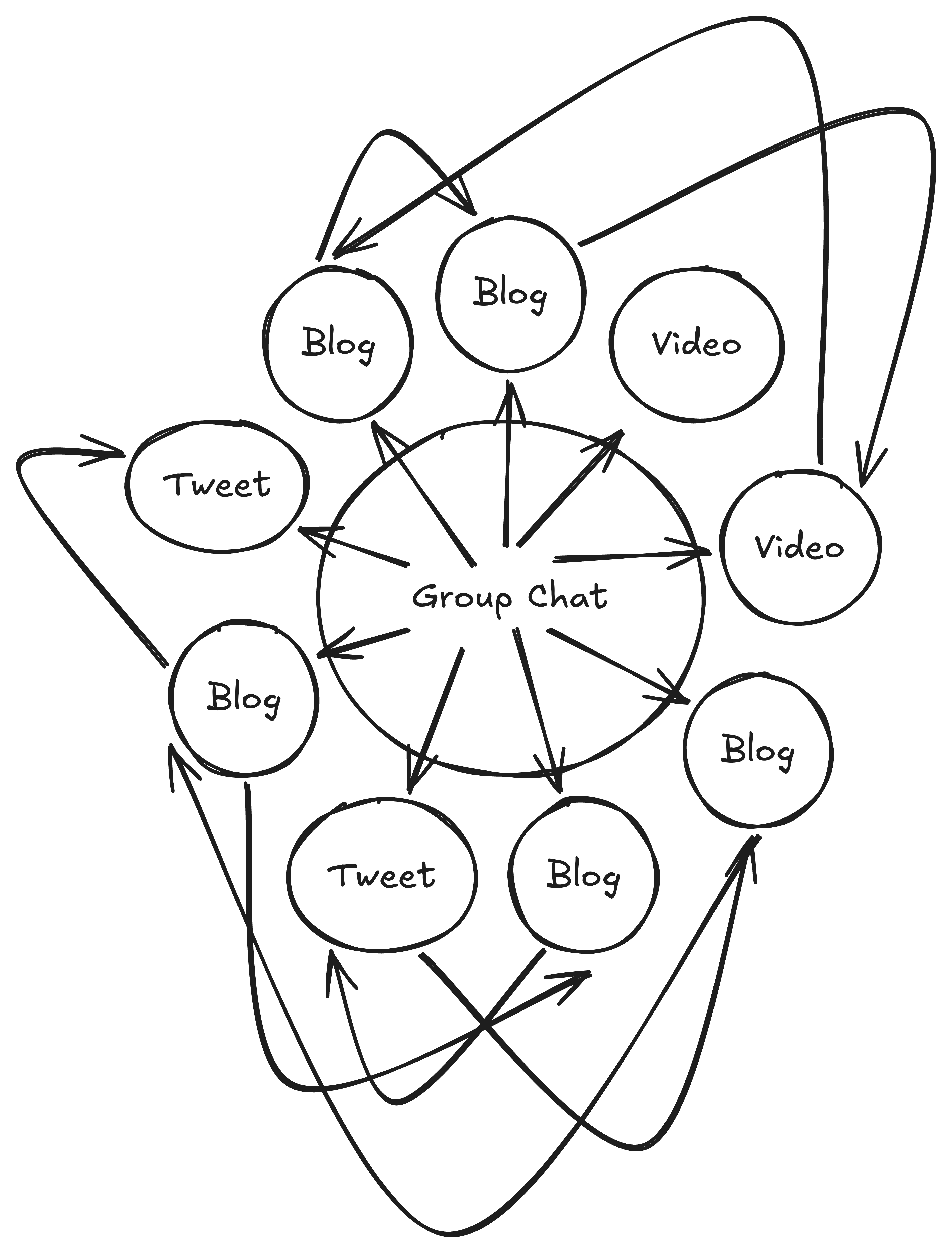
I created a group in the Critical Theory space on DFOS for people who want to talk about the philosophy of Slavoj Žižek. I don’t know if this will turn into something. I would love it if this place became somewhere Žižekians, Lacanians, Hegelians and Marxists could connect with each other and exchange ideas.
If you’re reading this, consider yourself invited.
The appeal of living in a small town is being surrounded by the right number of people whom you can care about. On the other hand, living in a big city might make you feel lonely in huge crowds.
Being a blogger in smallweb (or IndieWeb) is akin to living in a small town with one big exception: there’s no square in the middle of town, no town hall to gather around. In this sense maybe the proper analogy is a small island rather than a town. Smallweb can easily be an isolated experience.
Contrary to the corporate platforms where the connection is heavily mediated to be commodified, in smallweb the connection needs to be intentional. Connection here requires quilting points even if temporary.
I feel a recent change in the smallweb. It’s started to feel more connected than ever. Take Robert’s Junited for example: this year’s participants outnumber those of all previous years combined. I believe the reason for this liveliness is the emergence of blog directories and discovery platforms that act like quilting points for shared meaning. How would I have participated in junited if I hadn’t heard about it in the first place?
Bubbles is one example of a gathering location for the smallweb. It’s a blog aggregator where you can discover the newest posts published on a handful (~5000) blogs. Kagi smallweb is another one with a different approach. Bear Blog’s discover page is another one; although it’s platform-specific, it’s part of the smallweb in spirit. A recent addition is the standard.site protocol where stitching blogs together happens automatically thanks to AT Protocol. They are gravity points that halt the centrifugal drift of isolated blogs in the smallweb. Together, they create a landscape for shared discourse.
These developments are signs of the upcoming smallweb renaissance. Smallweb no longer feels like a refugee camp where people find themselves thrown together while escaping the high walls of the corporate web. We are now building something together. Our isolated islands have started to feel like an archipelago.
A few months ago I was reflecting on my need for a digital community:
I find myself once again yearning for a digital community. I believe the future of social media (for me) is some kind of invite-only group chat where the conversation flows like a river. It might live in Discord, Slack or even IRC, I don’t care. Physical community is important but as a millennial I need text-based friendships too.
Maybe I should have said hypertext instead of text-based. Hypertext is more than just text. Hypertext is images, links, pages… It’s the internet in its labyrinthine ways. This was also my thought process when I decided to start blogging on this domain, hypersubject.net. I was looking for a space where I can express myself, my subjectivity, via hypertext. Hence I merged the two: hypersubject.
Since creating hypersubject.net, I have been on a constant lookout for communities that I could participate in. I found a few in the wild.
I believe one should not make legible what depends on illegibility for its mere survival. The communities I list below, to the best of my knowledge, don’t depend on illegibility. They don’t really operate in public; all are either gatekept or have their own initiation processes to allow new members. However, if you think this post is exposing a community, let me know and I’ll take care of it.
I find myself once again yearning for a digital community. I believe the future of social media (for me) is some kind of invite-only group chat where the conversation flows like a river. It might live in Discord, Slack or even IRC, I don’t care1. Physical community is important but as a millennial I need text-based friendships too.
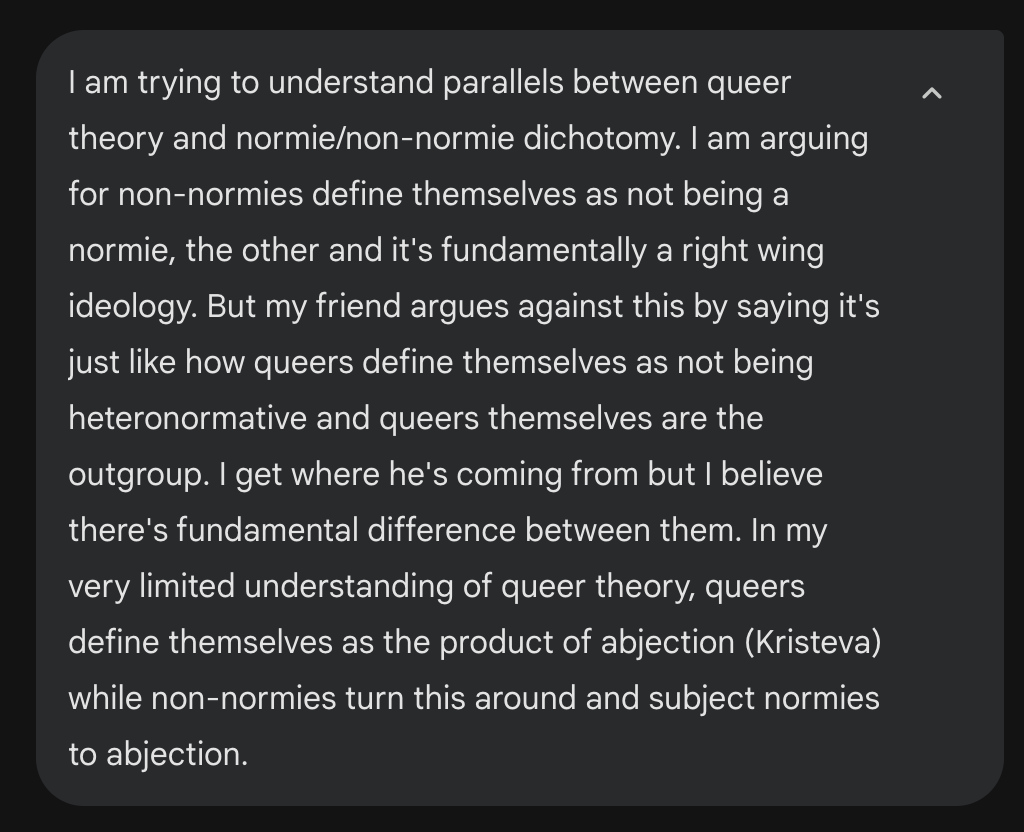
On Friday, I got a message from kerey on WhatsApp saying that “there is a need for a non-normie consortium”. It triggered a long conversation about the normie/non-normie dichotomy and whether this type of distinction is elitist or not. I collected my thoughts on this in Against the Non-Normie.
This type of interactions is at the heart of my ideal community. An off-hand remark starts a discussion where we argue and develop the idea and in the end this turns into some kind of writing. Then this writing gets responses from other members in the community in a variety of forms. A community that perpetually creates discourse for discourse’s sake.
This is not something that I might just land on. This type of community requires someone to build it from the ground up. “Somebody has to, and no one else will.”
Speaking of Against the Non-Normie, I feel a bit uncomfortable about that piece. I believe what I said there but I feel uneasy because of the process I wrote it with. During our conversation, kerey raised the similarity between non-normies and queer community. Since gender studies and queer theory are not my forte, I asked Gemini to make the connection:
So I used AI. This might be an acceptable use of AI but I also copied two sentences from its output:
“The ’normal’ (heteronormative) subject only exists because it has successfully ‘cast out’ (abjected) anything that threatens its boundaries.”
“Reclaiming ‘Queer’ is an act of strategic essentialism; it’s taking the site of your own exclusion and turning it into a fortress for survival.”
These are not things I couldn’t write myself but they were just sitting there for me to copy them. But the fact that I copied them verbatim into my post makes me feel ashamed. I don’t believe this stains the whole post and makes it slop though. Maybe I think too black-and-white about the AI problem. This will be a problem I will need to navigate in the near future.
My preference would be an IRC server to scratch my hacker itch, but it’s hard enough to make people join a Slack workspace. ↩︎
I wrote five different paragraphs to start this post and couldn’t stitch any of them together. So here are all five fragments.
My ability to do good is limited by my ability to work with others.
Three years ago multiple earthquakes devastated the southeastern region of Turkey. The things we saw were unimaginably bad. Within a few days people started organizing to collect food, clothes, sanitary products etc. I participated in none of it. One day, I felt disgusted with myself. A disaster happened; people were trying to collectively do what they can and I did nothing. Was I really this distant from the people around me? The answer was yes—I was that distant and alienated. I guess it’s no coincidence that I was also depressed as fuck.
There are some words that crumble if I try to define them. Agency is one. I’ll try anyways, even though it feels a bit cringey: Agency is your ability to enforce your will on the world. This definition might sound authoritarian, but I don’t think it is. “Enforcing” takes multiple forms. A ruler enforcing their will upon subjects is definitely the authoritarian version. But can’t there be a collaborative version? Like encouraging or even persuading others? Walking the path for a few steps, then turning back and waving for others to join you?
There is a motto in software development that I really like: “If you want to go fast, go alone. If you want to go far, go together.” It highlights the importance of collective agency. People getting together to build something is a powerful force that no individual can compete with, no matter how “agentic” they are. Unfortunately we’ve buried this feeling. But it’s down there and always ready to be rekindled. Collectivity is the core of the human condition. We are collective beings. We help, influence, persuade, abuse and oppress each other. No matter what we want to accomplish, it involves “the other” in some way or another.
Jenn writes about this collectivity of Effective Altruists (EAs) choosing the most effective charities for donations. It used to involve arguments over complicated spreadsheets in forums. Choosing the most effective way to use money to help others was a collective effort. Now, this is left to “professionals” who curate lists for EAs to choose from. I don’t think being a middle-class philanthropist is what Effective Altruism is truly about.